Kamis, 09 Desember 2010

CCNA Discovery 3 Module 8

| | 0 komentar

CCNA Discovery 3 Module 8 Exam Answers Version 4.0

1.      


1

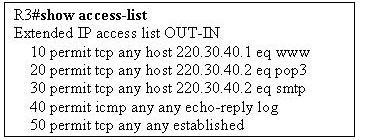
Refer to the exhibit. A network administrator needs to add the command deny ip 10.0.0.0 0.255.255.255 any log to R3. After adding the command, the administrator verifies the change using the show access-list command. What sequence number does the new entry have? 
• 60
2.      


2

Refer to the exhibit. What happens if the network administrator issues the commands shown when an ACL called Managers already exists on the router? 
• The new commands are added to the end of the current Managers ACL. 

3.      Why are inbound ACLs more efficient for the router than outbound ACLs? 
• Inbound ACLs deny packets before routing lookups are required. 


4.      


3

Refer to the exhibit. The network administrator of a company needs to configure the router RTA to allow its business partner (Partner A) to access the web server located in the internal network. The web server is assigned a private IP address, and a static NAT is configured on the router for its public IP address. Finally, the administrator adds the ACL. However, Partner A is denied access to the web server. What is the cause of the problem? 
• Port 80 should be specified in the ACL. 

5.      ACL logging generates what type of syslog message? 
• informational 

6.      Which two host addresses are included in the range specified by 172.16.31.64 0.0.0.31? (Choose two.) 
• 172.16.31.77 
• 172.16.31.78 

7.      Traffic from the 64.104.48.0 to 64.104.63.255 range must be denied access to the network. What wildcard mask would the network administrator configure in the access list to cover this range? 
• 0.0.15.255 

8.      ACLs are used primarily to filter traffic. What are two additional uses of ACLs? (Choose two.) 
• specifying internal hosts for NAT 
• identifying traffic for QoS 

9.      What can an administrator do to ensure that ICMP DoS attacks from the outside are mitigated as much as possible, without hampering connectivity tests initiated from the inside out? 
• Create an access list permitting only echo reply and destination unreachable packets from the outside. 

10.  What effect does the command reload in 30 have when entered into a router? 
• A router automatically reloads in 30 minutes.

11.  


4

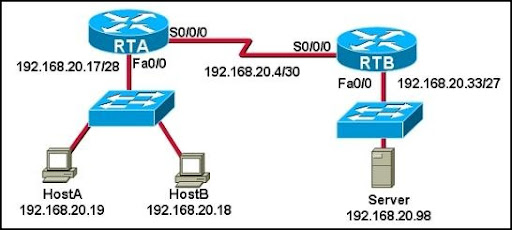
Refer to the exhibit. The following commands were entered on RTB. 
RTB(config)# access-list 4 deny 192.168.20.16 0.0.0.15 
RTB(config)# access-list 4 permit any 
RTB(config)# interface serial 0/0/0 
RTB(config-if)# ip access-group 4 in 
Which addresses do these commands block access to RTB? 
• 192.168.20.16 to 192.168.20.31* 
12.  


5

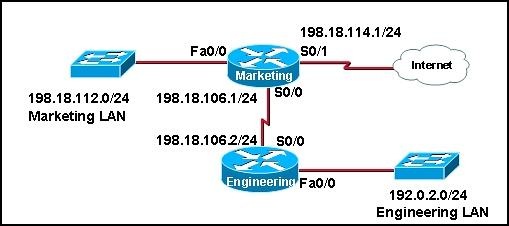
Refer to the exhibit. The new security policy for the company allows all IP traffic from the Engineering LAN to the Internet while only web traffic from the Marketing LAN is allowed to the Internet. Which ACL can be applied in the outbound direction of Serial 0/1 on the Marketing router to implement the new security policy? 
• access-list 137 permit ip 192.0.2.0 0.0.0.255 any 
access-list 137 permit tcp 198.18.112.0 0.0.0.255 any eq www 
13.  Which three statements are true concerning standard and extended ACLs? (Choose three.) 
• Extended ACLs are usually placed so that all packets go through the network and are filtered at the destination. 
• Standard ACLs are usually placed so that all packets go through the network and are filtered at the destination. 
• Standard ACLs filter based on source address only, and must be placed near the destination if other traffic is to flow. 
• Extended ACLs filter with many possible factors, and they allow only desired packets to pass through the network if placed near the source. 

14.  


6

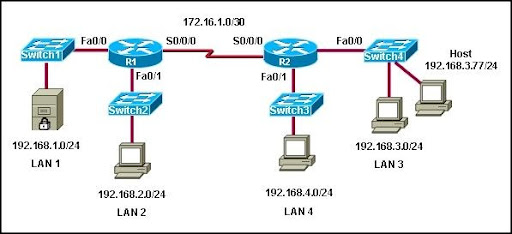
Refer to the exhibit. Company policy for the network that is shown indicates the following guidelines: 
1) All hosts on the 192.168.3.0/24 network, except host 192.168.3.77, should be able to reach the 192.168.2.0/24 network. 
2) All hosts on the 192.168.3.0/24 network should be able to reach the 192.168.1.0/24 network. 
3) All other traffic originating from the 192.168.3.0 network should be denied.
Which set of ACL statements meets the stated requirements when they are applied to the Fa0/0 interface of router R2 in the inbound direction? 
• access-list 101 deny ip 192.168.3.77 0.0.0.0 192.168.2.0 0.0.0.255 
access-list 101 permit ip 192.168.3.0 0.0.0.255 192.168.2.0 0.0.0.255 
access-list 101 permit ip 192.168.3.0 0.0.0.255 192.168.1.0 0.0.0.255 
15.  


7

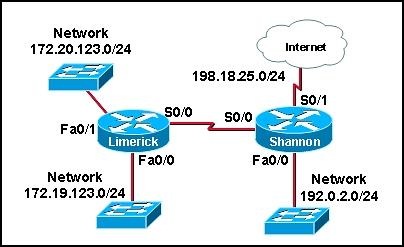
Hosts from the Limerick LAN are not allowed access to the Shannon LAN but should be able to access the Internet. Which set of commands will create a standard ACL that will apply to traffic on the Shannon router interface Fa0/0 implementing this security? 
• access-list 56 deny 172.19.123.0 0.0.0.255 
access-list 56 permit any 
16.  


8

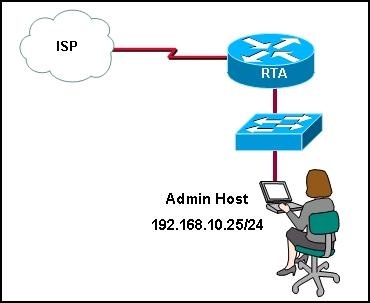
Refer to the exhibit. A network administrator needs to configure an access list that will allow the management host with an IP address of 192.168.10.25/24 to be the only host to remotely access and configure router RTA. All vty and enable passwords are configured on the router. Which group of commands will accomplish this task? 
• Router(config)# access-list 101 permit tcp any 192.168.10.25 0.0.0.0 eq telnet 
Router(config)# access-list 101 deny ip any any 
Router(config)# int s0/0 
Router(config-if)# ip access-group 101 in 
Router(config-if)# int fa0/0 
Router(config-if)#ip access-group 101 in 
17.  Which ACL permits host 10.220.158.10 access to the web server 192.168.3.244? 
• access-list 101 permit tcp 10.220.158.10 0.0.0.0 host 192.168.3.224 eq 80

18.  Which wildcard mask would match the host range for the subnet 192.16.5.32 /27? 
• 0.0.0.31

19.  A security administrator wants to secure password exchanges on the vty lines on all routers in the enterprise. What option should be implemented to ensure that passwords are not sent in clear text across the public network? 
• Use only Secure Shell (SSH) on the vty lines.

20.  


9

Refer to the exhibit. An administrator notes a significant increase in the amount of traffic entering the network from the ISP. The administrator clears the access-list counters. After a few minutes, the administrator again checks the access-list table. What can be concluded from the most recent output shown? 
• A large amount of ICMP traffic is being denied at the interface, which can be an indication of a DoS attack. 

Read more...

CCNA Discovery 3 Module 7

| | 0 komentar

CCNA Discovery 3 Module 7 Exam Answers Version 4.0

1.      Why are Network Control Protocols used in PPP? 
• to allow multiple Layer 3 protocols to operate over the same physical link

2.       What is the data transmission rate for the DS0 standard? 
• 64 kb/s 

3.      In which two layers of the OSI model are key differences found between a LAN and a WAN. (Choose two.) 
• Layer 1 
• Layer 2 

4.      Which statement is true about the Cisco implementation of the HDLC protocol? 
• It is the default encapsulation for serial interfaces on Cisco routers. 

5.      

image

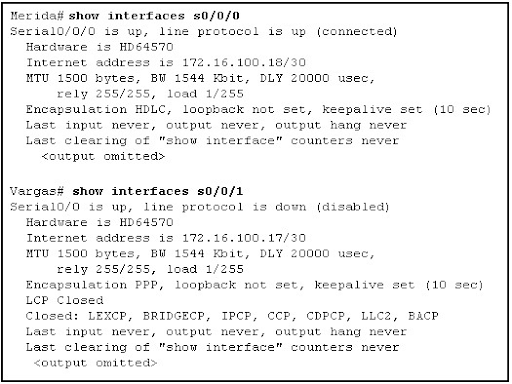
Refer to the exhibit. A network administrator has a connectivity problem between the serial interfaces of Merida and Vargas. What is the cause of the problem? 
• The encapsulation is misconfigured. 

6.      

image

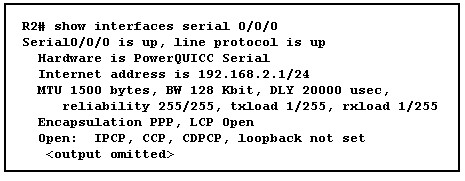
Refer to the exhibit. What statement is true about the exhibited output? 
• LCP and NCP negotiation is complete, and the data link service is available to carry packets.

7.      Which three statements are true regarding LCP? (Choose three.) 
• It is responsible for negotiating link establishment. 
• It terminates the link upon user request or the expiration of an inactivity timer. 
• It can test the link to determine if link quality is sufficient to bring up the link. 

8.      Why are Frame Relay paths referred to as virtual? 
• The physical circuits inside the Frame Relay cloud do not contain exclusive links for a specific Frame Relay connection.

9.      What best describes the use of a data-link connection identifier (DLCI)? 
• an address identifying a virtual circuit 

10.  What two services allow the router to dynamically map data link layer addresses to network layer addresses Frame Relay network? (Choose two.) 
• Inverse ARP 
• LMI status messages

11.  Which three statements describe functions of the Point-to-Point Protocol with regards to the OSI model?(Choose three.) 
• provides a mechanism to multiplex several network layer protocols 
• can be configured on both synchronous and asynchronous serial interfaces 
• uses Layer 3 of the OSI model to establish and maintain a session between devices 
• uses network control protocols to test and maintain connectivity between devices

12.  At what physical location does the responsibility for a WAN connection change from the user to the service provider? 
• demarcation point 

13.  What does a Frame Relay switch use to inform the sender that there is congestion? 
• BECN 

14.  

image

Refer to the exhibit. What statement is true about the debug output? 
• The routers have different CHAP passwords configured. 

15.  Which two statements describe the function of time-division multiplexing? (Choose two.) 
• Multiple data streams share one common channel. 
• Time slots go unused if a sender has nothing to transmit. 

16.  When customers use credit cards to make purchases at a small business, a modem is heard dialing a telephone number to transfer the transaction data to the central office. What type of WAN serial connection is in use? 
• circuit switched 

17.  Which best describes data communications equipment (DCE)? 
• equipment that forwards data and is responsible for the clocking signal

18.  Permanent virtual circuits and switched virtual circuits are both part of which option for WAN connectivity? 
• packet switching 

19.  Which field of a frame uses error detection mechanisms to verify that the frame is not damaged intransit? 
• FCS 

20.  What occurs in the encapsulation process as a data packet moves from a LAN across a WAN? 
• The Layer 2 encapsulation changes to a format that is appropriate for the WAN technology. 

21.  

image

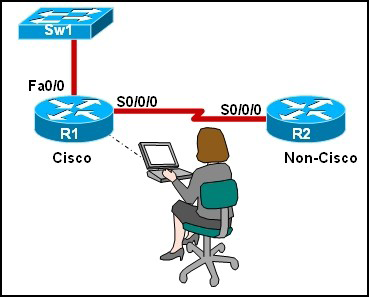
Refer to the exhibit. The network administrator is configuring R1 to connect to R2, which is a non-Cisco router. Which encapsulation method will need to be configured for communication to occur? 
• PPP

22.   A company is implementing dialup services for remote workers to connect to the local network. The company uses multiple Layer 3 protocols and requires authentication for security. Which protocol should be used for this remote access? 
• PPP 

23.  Which two options can LCP negotiate? (Choose two.) 
• compression 
• authentication 

24.  What statement best describes cell switching? 
• It creates fixed-length packets that traverse virtual circuits.
Read more...

CCNA Discovery 3 Module 6

| | 0 komentar

CCNA Discovery 3 Module 6 Exam Answers Version 4.0

1.      

          1

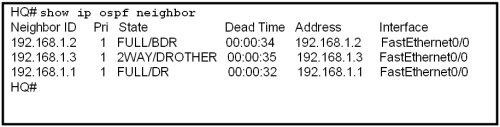
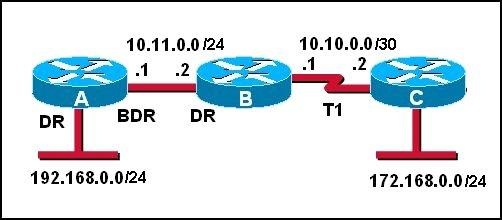
Refer to the exhibit. What statement describes the DR/BDR relationship of the HQ router? 
• HQ is a DROTHER. 

2.      Which two features are associated with Frame Relay OSPF point-to-multipoint environments? (Choose two.) 
• A DR is not elected. 
• OSPF neighbor routers are statically defined. 

3.      

2

Refer to the exhibit. How was the OSPF default gateway entry for R2 determined? 
• The default-information originate command is applied on R1. 

4.      What is always required for OSPF routers to share routing information? 
• neighbor adjacencies 

5.      

3

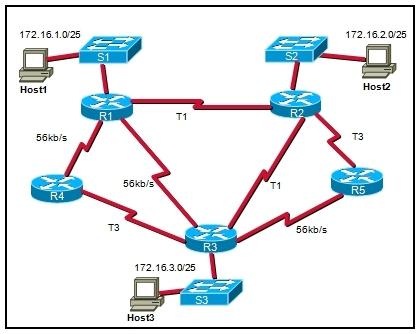
Refer to the exhibit. A network administrator has implemented OSPF and the network has converged. If all router interfaces are enabled and functional, what route will OSPF view as lowest cost when moving frames from Host3 to Host1? 
• R3 to R2 to R1 

6.      

4

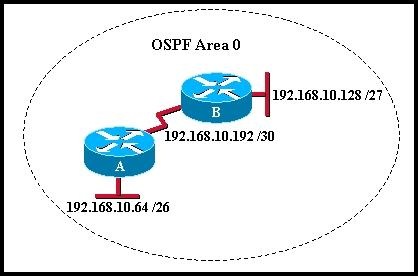
Refer to the exhibit. Which commands configure router A for OSPF? 
• router ospf 1 
network 192.168.10.64 0.0.0.63 area 0 
network 192.168.10.192 0.0.0.3 area 0 

7.      

5

Refer to the exhibit. Which network statement configures the home router to allow all the interfaces to participate in OSPF? 
• network 10.8.0.0 0.3.255.255 area 0 

8.      Which statement is true regarding OSPF DR and BDR elections? 
• The router with the highest OSPF priority setting wins the election for DR. 


9.      

6

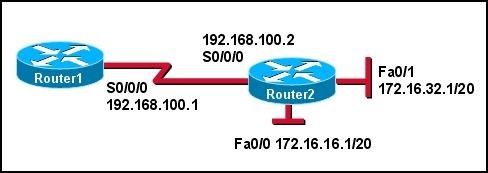
Refer to the exhibit. The network administrator would like only the 172.16.32.0 network advertised to Router1. Which OSPF network command accomplishes this? 
• Router2(config-router)# network 172.16.32.0 0.0.15.255 area 0 

10.  Which two statements describe the operation of link-state routing protocols? (Choose two.) 
• All routers in the same area have identical link-state databases when converged. 
• Calculating the shortest path for each destination is accomplished with the SPF algorithm.

11.  

7

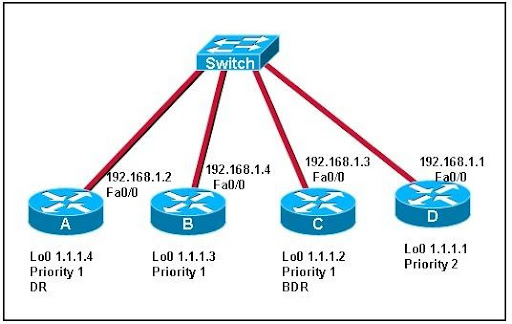
Refer to the exhibit. Routers A, B, and C are part of the existing OSPF network. Router D has been added to the network. All routers are running OSPF and have the indicated priorities applied to the interface. What is the DR/BDR status immediately after router D is added to the existing network? . 
• The DR and BDR do not change until the next election. 

12.  Which two statements describe the use of OSPF DR/BDR elections? (Choose two.) 
• Elections are required in broadcast multiaccess networks. 
• Elections are sometimes required in NBMA networks.

13.  

8

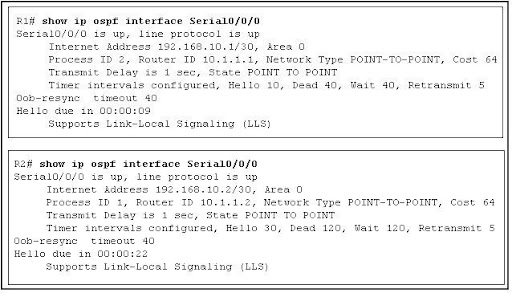
Refer to the exhibit. As part of an OSPF network, R1 and R2 are trying to become adjacent neighbors. Although it appears that the two systems are communicating, neither of the routing tables include OSPF routes received from its neighbor. What could be responsible for this situation? 
• The timer intervals on the routers do not match. 

14.  

9

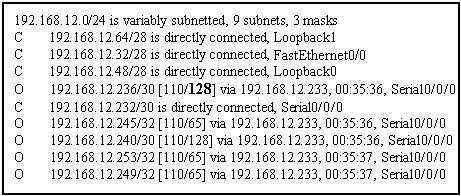
Refer to the exhibit. What is the purpose of the value 128 shown in bold? 
• It is the OSPF cost metric. 

15.  

10

Refer to the exhibit. What is the purpose of the configuration commands added on router B? 
• provides a stable OSPF router ID on router B 

16.  

11

Refer to the exhibit. The command ip route 10.16.1.64 255.255.255.252 s0/0/0 is entered into the router. Why does network 10.16.1.64/30 appear in the routing table in addition to network 10.16.1.64/27? 
• The router views 10.16.1.64/30 and 10.16.1.64/27 as two different networks. 

17.  What is the primary difference between link-state protocols and distance vector protocols with regard to route calculation? 
• Distance vector protocols take existing routes from their neighbors and add to them. Link-state protocols independently calculate full routes. 

18.  What range of networks are advertised in the OSPF updates by the command Router1(config-router)# network 192.168.0.0 0.0.15.255 area 0? 
• 192.168.0.0/24 through 192.168.15.0/24 

19.  

12

Refer to the exhibit. When establishing adjacency relationships, which IP address would router A use to send hello packets to router B? 
• 224.0.0.5 

20.  


13

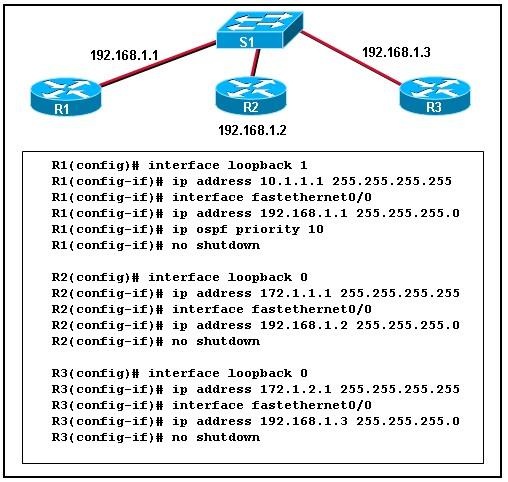
Refer to the exhibit. Which router will be elected the DR and which will become the BDR? 
• R1 will be DR and R3 will be BDR. 

21.  When compared to a distance vector routing protocol, what is a benefit of the hierarchical design approach that is used in large OSPF networks? 
• isolation of network instability 

22.   What are two advantages of using a link-state routing protocol instead of a distance vector routing protocol? (Choose two.) 
• Routers have direct knowledge of all links in the network and how they are connected. 
• After the initial LSA flooding, routers generally require less bandwidth to communicate changes in a topology. 

23.  If a network has converged, what is true about the link-state database held by each router in the same OSPF area? 
• Each router has a link-state database containing the same status information. 

24.  

14

Refer to the exhibit. RTRC was recently configured and is not sending the proper OSPF routes to RTRB, as shown in the RTRB routing table. Based on the RTRC configuration, what is most likely the problem? 
• The OSPF routing configuration on RTRC has a missing or incorrect network statement.
Read more...

CCNA Discovery 3 Module 5

| | 0 komentar

CCNA Discovery 3

 Module 5 Exam Answers Version 4.0
1.      What three statements are true about routers that are configured for EIGRP? (Choose three.) 
• They can support multiple routed protocols 
• They send partial routing updates in response to topology changes. 
• They use hello packets to inform neighboring routers of their status.

2.      Given the following commands: 
Router(config)# router rip 
Router(config-router)# network 192.31.7.0 
What three conclusions can be determined based on the commands used on the router? (Choose three.) 
• A link-state routing protocol is used. 
• A distance vector routing protocol is used. 
• Routing updates broadcast every 30 seconds. 
• Hop count is the only metric used for route selection. 

3.       What is indicated when an EIGRP route is in the passive state? 
• The route is viable and can be used to forward traffic.

4.      What two problems may occur if the EIGRP default bandwidth for a serial link is higher than the actual bandwidth? (Choose two.) 
• Suboptimal paths will be selected. 
• Network convergence may be affected.

5.      What is the default administrative distance for EIGRP internal routes? 
• 90 

6.      A network administrator issues the command show ip route and sees this line of output: 
192.168.3.0/24 [120/2] via 192.168.2.2, 00:00:05, Serial0/0 
What two pieces of information can be obtained from the output? (Choose two.) 
• RIP is the routing protocol configured. 
• The metric for this route is 2. 


7. 
1

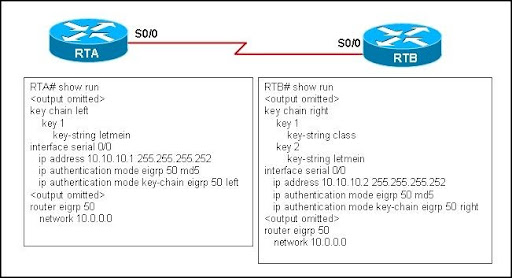
Refer to the exhibit. Which statement is true about the EIGRP authentication configuration? 
• RTA and RTB will accept updates from each other. 

8.      Which Layer 4 protocol does EIGRP use to provide reliability for the transmission of routing information? 
• RTP 

9.      


            2 

Refer to the exhibit. Routers RTR-1 and RTR-3 are completely configured. The administrator needs to configure the routing protocol on router RTR-2 so that communication occurs throughout the network. Which group of commands will successfully configure EIGRP on RTR-2? 
• RTR-2(config)# router eigrp 1 
RTR-2(config-router)# network 198.18.76.0 

10.  What prevents RIPv1 updates from being correctly advertised? 
• the use of variable length subnet masks 

11.  What does a router that is running RIP use to determine the best path to take when forwarding data? 
• the calculated metric for the destination network 

12.  What is the purpose of the network command when RIP is being configured as the routing protocol?
• It identifies the directly connected networks that will be included in the RIP routing updates.

13.   How do EIGRP routers establish and maintain neighbor relationships? 
• by exchanging hello packets with neighboring routers 

14.  
3

Refer to the exhibit. Routers A and B have EIGRP configured and automatic summarization has been disabled on both routers. Which router command will summarize the attached routes? 
• ip summary-address eigrp 1 192.168.10.64 255.255.255.192 

15.  How often does RIPv2 send routing table updates, by default? 
• every 30 seconds 

16.  
4
Refer to the exhibit. A network administrator is troubleshooting a routing problem. When the show ip route command is entered on RTR-1, only the serial link between RTR-2 and RTR-3 has been learned from the RIP routing protocol. What are two issues? (Choose two.) 
• RIPv1 is a classful routing protocol. 
• RIPv1 does not support subnetting. 
• The Ethernet networks on RTR-2 and RTR-3 were not entered correctly in the network statements on these routers. 
• RIPv1 does not support VLSM. 
• RIPv1 is a classless routing protocol.

17.   What two statements are correct regarding EIGRP authentication? (Choose two.) 
• EIGRP authentication uses the MD5 algorithm. 
• EIGRP authentication uses a pre-shared key. 

18.  When should EIGRP automatic summarization be turned off? 
• when a network contains discontiguous network addresses 

19.  What is the maximum number of hops that RIP will attempt before it considers the destination unreachable? 
• 15 hops 

20.  What two statements are true regarding EIGRP tables? (Choose two.) 
• A feasible successor route can be found in the topology table. 
• The topology table shows whether a route is in the passive or active state. 

       21. 

          5

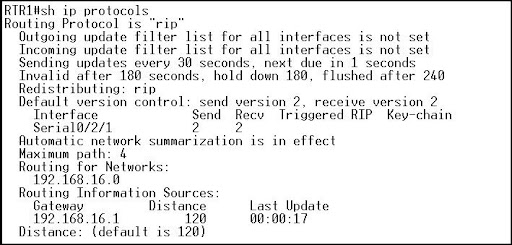
          Refer to the exhibit. Which statement is true about the output from the show ip protocols command? 
          • RIPv2 is configured on this router. 

Read more...

Rabu, 01 Desember 2010

CCNA Discovery 3 Module 4 Exam Answers Version 4.0

| | 0 komentar

CCNA Discovery 3 Module 4 Exam Answers Version 4.0

1. A network engineer is implementing a network design using VLSM for network 192.168.1.0/24. After subnetting the network, the engineer has decided to take one of the subnets, 192.168.1.16/28 and subnet it further to provide for point-to-point serial link addresses. What is the maximum number of subnets that can be created from the 192.168.1.16/28 subnet for serial connections? 
• 4 

2. When running NAT, what is the purpose of address overloading? 
• allow multiple inside addresses to share a single global address 

3. What two advantages does CIDR provide to a network? (Choose two.) 
• dynamic address assignment 
• reduced routing update traffic 

4. How does a router keep track of which inside local address is used when NAT overload is configured?
• The router uses TCP or UDP port numbers. 

5. What is a characteristic of a classful routing protocol on the network?  
• Updates received by a router in a different major network have the default mask applied. 

6. Refer to the exhibit. Which address is an inside global address? 
• 198.18.1.55 

7. Refer to the exhibit. All networks that are shown have a /24 prefix. Assuming that all routes have been discovered by all routers in the network, which address will successfully summarize only the networks that are shown?  
• 192.168.16.0/21 

8. What is the CIDR prefix designation that summarizes the entire reserved Class B RFC 1918 internal address range? 
• /16 

9. Which NAT term refers to the IP address of your inside host as it appears to the outside network? 
• inside local IP address  

10. A network administrator is asked to design a new addressing scheme for a corporate network. Presently, there are 500 users at the head office, 200 users at sales, 425 at manufacturing, and 50 at the research site. Which statement defines the correct VLSM addressing map with minimal waste using the 172.16.0.0/16 network?  
• 172.16.2.0/23 head office
172.16.4.0/23 manufacturing
172.16.6.0/24 sales
172.16.7.0/26 research
  

11. A company using a Class B IP addressing scheme needs as many as 100 subnetworks. Assuming that variable length subnetting is not used and all subnets require at least 300 hosts, what subnet mask is appropriate to use? 
• 255.255.254.0 

12. Host A in the exhibit is assigned the IP address 10.118.197.55/20. How many more network devices can be added to this same subnetwork? 
• 4093 

13. Refer to the exhibit. RIP version 2 is configured as the network routing protocol and all of the default parameters remain the same. Which update is sent from R2 to R3 about the 10.16.1.0/24 network connected to R1? 
• 10.16.0.0/16 

14. What range of networks are summarized by the address and mask, 192.168.32.0/19?
• 192.168.32.0/24 – 192.168.63.0/24

15. Refer to the exhibit. Based on the output of the show ip nat translations command, which kind of address translation is in effect on this router?
• overload

16. How many addresses will be available for dynamic NAT translation when a router is configured with the following commands?
• 8

17. Refer to the exhibit. Which two IP addresses could be assigned to the hosts that are shown in the exhibit? (Choose two.)
• 192.168.65.35
• 192.168.65.60


18. What are the network and broadcast addresses for host 192.168.100.130/27? (Choose two.)
• network 192.168.100.128
• broadcast 192.168.100.159

19. Refer to the exhibit. Which two are valid VLSM network addresses for the serial link between Router1 and Router2? (Choose two.)
• 192.168.1.4/30
• 192.168.1.8/30


20. When configuring NAT on a Cisco router, what is the inside local IP address?
• **c the IP address of an inside host as it appears to the inside network 
Read more...

My Playlist

Pages

Followers

Diberdayakan oleh Blogger.


top